
Showing posts with label management. Show all posts
Showing posts with label management. Show all posts
Friday, September 8, 2017
New Business Book Summary Available for Looptail

Friday, January 27, 2017
New Business Book Summary Available for The Seven Principles of Professional Services

Wednesday, November 23, 2016
New Business Book Summary Available for The Effective Manager

Most managers are ineffective at their jobs because they have not been trained to successfully lead their people. Based on interviews with 91,000 managers, as well as personal research and case studies, Mark Horstman and his business partner Mike Auzenne have developed a step-by-step plan to train managers in achieving their two most important responsibilities: getting the most out of their teams and retaining direct reports. They present their plan in their popular online podcast, Manager Tools. In The Effective Manager, Horstman crystallizes the lessons of this podcast into an easy-to-use reference tool that compiles the Manager Tools training system into one accessible resource.
Friday, July 29, 2016
New Business Book Summary Available for Chess Not Checkers

As Mark Miller explains in Chess Not Checkers, leading a company can be like a game of checkers--highly reactionary and fast-paced. However, in today's complicated business climate, the game is changing, and leadership is now more like a game of chess. In chess, strategy and focus are vital and individual pieces can make unique contributions. Chess Not Checkers follows the fictional story of CEO Blake Brown as he begins his journey to improve the performance of his company and increase employee morale by using key moves from the world of chess.
Friday, October 23, 2015
New Business Book Summary Available for Dare to Serve

Dare to Serve by Cheryl Bachelder focuses on servant leadership, which puts the needs of others ahead of the needs of leaders. Bachelder outlines the thinking behind this concept, detailing how organizations will benefit at every level (including the bottom line) by adopting a system of respect, accountability, and humility.
Friday, October 2, 2015
New Business Book Summary Available for HBR's 10 Must Reads 2015

Developing high-performance leaders, maximizing marketing effectiveness, and creating an engaged company culture are just a few of the common issues that challenge leaders and managers across companies and industries. In HBR's 10 Must Reads 2015, editors at the Harvard Business Review address some of the most common leadership and management issues through a collection of essays written by a wide variety of respected business experts.
Friday, May 8, 2015
New Business Book Summary Available for Seven Disciplines of a Leader

Leaders make or break organizations. To help organizations succeed, Jeff Wolf and Ken Shelton have condensed Wolf’s Leadership Development Program into their book, Seven Disciplines of a Leader. It is based on Wolf’s 14 years of executive coaching and management training for international clients. Readers will learn how to motivate and inspire people to improve decision making, teamwork, and employee engagement. As a result, they will help their organizations attract the best people, which is the key to organizational excellence and, ultimately, profitability and growth. Wolf and Shelton have drawn on real-world examples—both positive and negative—to develop and illustrate their ideas. They also emphasize the “soft skills” that separate managers from true leaders.
Friday, February 6, 2015
New Summary Available for Uncommon Leadership
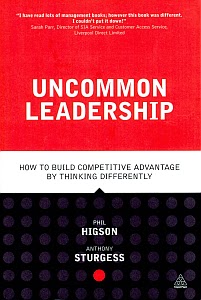
Phil Higson and Anthony Sturgess believe that what is known about good leadership is not commonly practiced. They have written Uncommon Leadership to help bring effective leadership practices out of the shadows. Their five-part model helps leaders identify solutions, change their companies’ cultures, focus on customer service, serve employees, and share power.
Friday, June 13, 2014
HBR Guide to Project Management

Friday, April 25, 2014
The Necessity of Strangers

Friday, April 11, 2014
I Hear You

Friday, February 28, 2014

The main challenge of leadership is that it is poorly understood, and the public associates leadership with scandal and distrust. Also, people in leadership roles often do not understand how to lead. In The Leadership Contract, Vince Molinaro presents a fresh look at leadership, and offers a tangible, concise, and easy-to-understand document that outlines what leadership is: making tough decisions, obligation, hard work, and community. Molinaro explores the risks and rewards of leadership in the context of these concepts. He captures key lessons gleaned from his experiences as a consultant for leaders in a variety of organizations, and reframes leadership as an opportunity to build successful and sustainable organizations.
Friday, February 21, 2014
The Profitable Consultant

Thursday, February 6, 2014
Simply Management

Friday, January 24, 2014

Friday, January 10, 2014

Monday, December 2, 2013

Friday, November 8, 2013

Monday, April 30, 2012
Fire, Flow, and Future
Today's business managers benefit from an unprecedented number of quality improvement tools, such as lean manufacturing, re-engineering, Total Quality Management, and Six Sigma. Yet despite substantial investments, many companies continue to see slow improvement in the quality of their products, services, and processes.

Management is routinely troubled by questions such as "Why are my sales dropping off?"; "What can I do about excessive scrap?" and "How do I reduce high turnover?" How they decide to answer those questions has a measurable impact on both quality and the bottom line.
LEO can help organizations find ideal solutions to these questions not because it is a better management tool than the likes of Six Sigma, but because it causes a shift in every person's frame of mind, affecting how they approach problems and how they decide which actions to take. LEO is a broad methodology that transforms how existing management tools are used, and it operates best when used by people at all levels in an organization.
While designing LEO, there are three scenarios with the most room for quality improvement: Fire, Flow, and Future. In a Fire deployment, LEO is used to solve an isolated, often unexpected problem that needs immediate attention and an accompanying change in quality -- for example, when a food manufacturer's product is suddenly and inexplicably underweight.
A Flow deployment seeks to improve quality in the operational processes of an organization--for example, a hospital's procedure for hiring nurses or a manufacturer's process for creating an RFQ (a request for quote). In a Future deployment, quality is built into the process of innovation.
All three of these scenarios are focused on improving an existing product or service or developing an entirely new one. Regardless of the type of deployment, a LEO team should be appointed to follow same three-step process of Listen, Enrich, and Optimize.
While the composition of the team will vary by deployment, in general it should be led by someone from management, and team members should be chosen based on who the scenario effects and requires input from. No deployment can succeed unless the executive cadre is actively supporting it each and every day.
This article is based on the book "Power of LEO." The book summary is available online at Business Book Summaries.
Monday, December 26, 2011
Finding Recognition Everywhere
Effective recognition relies heavily on intrinsic motivation. Each employee has individual needs and expectations that motivate their actions.

Most people are intrinsically motivated by varying degrees of achievement, affiliation, or power/control. Supervisors present workplace goals based on these motivators.
Additionally, they must use extrinsic motivation properly by incorporating meaningful recognition into bonuses, incentives, contests, and prizes. Employees can also receive recognition that works by providing quality products and services to customers.
A workplace that allows people to contribute in a meaningful way will give their job purpose. Managers should find ways to help their employees take pride in their work and boost their team or organization's reputation in the community.
Creating an atmosphere of trustworthiness is a powerful form of intrinsic recognition. For example, Best Buy uses a system called ROWE ("results-only work environment"), in which employees chose how, when, and where their work is performed.
Supervisors only measure if the work is accomplished. This system demonstrates trust in employees and has reduced voluntary turnover and increased productivity 42 percent.
An organization can also show employees they are recognized by providing opportunities for growth. In-house vocational counselors are essential to helping employees find new areas of challenge and advancement.
People often leave a job to pursue growth opportunities in their career. By proactively encouraging and creating career furtherance from within, organizations retain valuable employees and foster company loyalty.
Fair pay, benefits, health insurance, vacation time, and a quality working environment also affect whether an employee feels recognized. People do not necessarily receive recognition from a fair salary and healthy work environment, but their absence will be perceived as a lack of recognition.
This article is based on the book 'Make Their Day!' The book summary is available online at Business Book Summaries.
Subscribe to:
Posts (Atom)