Pages

Showing posts with label goals. Show all posts

Friday, July 8, 2016

New Business Book Summary Available for Darn Easy

 Darn Easy

Darn Easy instills basic principles for success with intuition and faith to create a simple yet inspiring formula for positive growth. Peggy McColl and Brian Proctor write from the perspective of successful businesspeople, providing advice and examples from their own journeys toward achieving goals. They simplify the processes of generating emotional as well as financial income, building on natural talents, enjoying work, and ultimately achieving a lifestyle of ease, so that readers can believe in their dreams and take steps to achieve them.

Friday, March 20, 2015

New Summary Available for HARD Goals

Many people attribute not achieving their goals to poor execution or a lack of motivation. The truth is that most goals fail because they were subpar from the moment they were set. In HARD Goals, author and CEO of Leadership IQ Mark Murphy taps into scientific research to demonstrate that by utilizing psychological tricks and techniques, people can not only set better goals, but also kick-start the motivation necessary to see them all the way through to completion. To this end, Murphy provides readers with the essential steps to develop superior, inspirational goals along with insight into their successful implementation.

Friday, February 27, 2015

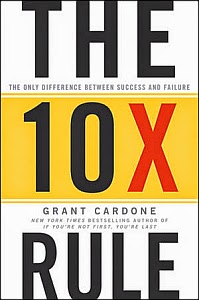
New Summary Available for The 10X Rule

People have long sought a definitive answer to why some people succeed in life and in business and why others do not. While there are no shortcuts or magic bullets to achieving success, author Grant Cardone believes he can point to a discipline and mind-set that transforms average people into high achievers. In The 10X Rule, Cardone explains that those who attain great success have bold goals and high levels of activity. They set targets that are 10 times higher than they think necessary and put forth 10 times the effort that others do. This a principle can be used to become a high achiever in any aspect of life—spiritual, physical, mental, emotional, relational, career, or financial—and outlines how both individuals and organizations should manage the formation and realization of all their goals. The 10X Rule establishes why success is important, why realistic goals are useless, and why massive levels of action are imperative.

Friday, October 10, 2014

New summary available for Boundaries for Leaders

Boundaries for Leaders by Dr. Henry Cloud offers insight into the roles of the leaders in contemporary businesses. Not only must leaders set production goals and provide guidance, they must also define boundaries that keep negativity out of the workplace. Dr. Cloud, a psychologist, bases many of his leadership principles on the way people’s brains function in different situations. He uses scientific data to illustrate how negative stress shuts down productive activity while positive stress inspires high performance. Additionally, leaders are responsible for helping teams of workers build mutual trust that allows each member to realize his or her full potential. Leaders themselves must earn employee trust to be effective in leading others toward attaining organizational goals.

Thursday, October 13, 2011

Clarifying Intent

A very important aspect in the art of convening is defining the desired result or intention of the meeting. This step is necessary because if a leader does not fully consider the intention of a meeting, the intentions can be confusing or conflicting.


The biggest challenge conveners face when trying to define their intent is doubt. Doubt can manifest itself in the form of fear.

It is important for a convener to be fearless when examining their intentions and to consider how those intentions align with who she is by asking the following questions:


  • What are my intentions? 
  • Are they in line with who I am? 
  • How will we relate to one another? 


By clarifying intentions, meeting leaders identify motives or desires that might distract them or others from the primary goal. It takes patience, but conveners should try to look past their immediate conclusions and try to examine their deepest intent.

Armed with the knowledge of their true intentions, conveners will have confidence and energy to pursue the next steps toward authentic engagement. One good way for meeting leaders to do this is to sit down and write for at least 30 minutes.

They should first ask themselves, "Who am I and what am I doing right now?" Then, they should take that self-knowledge into consideration while writing down an intention for their next meeting or gathering.

This article is based on the book "The Art of Convening." The book summary is available online at Business Book Summaries.

Tuesday, March 29, 2011

The Cost of the Generational Divide

The generation gap is most often noticed when older workers are trying to mentor or motivate younger workers, and younger workers are not receptive. The younger workers complain they just want to hear the company goals and be set free to work rather than be forced to sit through a pep rally.


The older workers complain the younger workers do not respect tradition and have no sense of teamwork or any work ethic, for that matter. This kind of miscommunication happens all the time in companies all over the nation.

Every employee is valuable and brings skills and talent to the table. Miscommunication and conflict across generations impact a company’s productivity and bottom line.

Lost revenue and turnover, costly consequences of the generational divide, can be averted if managers learn to bring employees together.

Generational harmony impacts a company’s profitability. In 2005, it was predicted that unemployment would be at five percent at the end of 2006.

Low unemployment and steady job growth usually makes employees comfortable enough to look for jobs with better opportunities and better benefits. It was predicted that by 2010 the United States would be short 10 million workers with the right skills.

The U.S. was short only three to four million workers in the late 1990s, and hiring managers were scrambling to fill empty chairs. Organizations need a plan to recruit and retain employees from all generations with the right skills.

Turnover is expensive, costing “50 to 150 percent of a departing employee’s annual wage.” It is time for organizations to assess the demographics of their workforce to make sure they have the “bench strength” for projected retirements.

Managers can take the following actions to immediately improve retention:
• Evaluate age of workforce.
• Develop strategies to attract and retain those about to retire.
• Identify ways to operate more efficiently.
• Create a formal process to assess manpower over the next five to 10 years.
• Evaluate current turnover.
• Establish two-way communication on all issues.
• Assess skill development commitments.
• Proactively work to retain talent.

Managers should be developing strategies to coax ready-to-retire workers into semi-retirement so they can mentor younger workers to do their jobs. Employers should not only be thinking of ways to retain quality employees, but also how to retain valued customers and colleagues. Generational misperceptions can injure these critical business relationships.

People are a business’s key resource. It is the people that make a company successful. Managers need to understand the demographics of their workforce, and to do whatever they can to retain and develop the skills of all their employees, regardless of generation. This plan of action will minimize turnover and increase the bottom line.

Bridging the Generation Gap was written as a reference tool for managers confronted with recruiting, retaining, and balancing the needs of five generations of employees. To access the book summary, please go to BusinessSummaries.com.